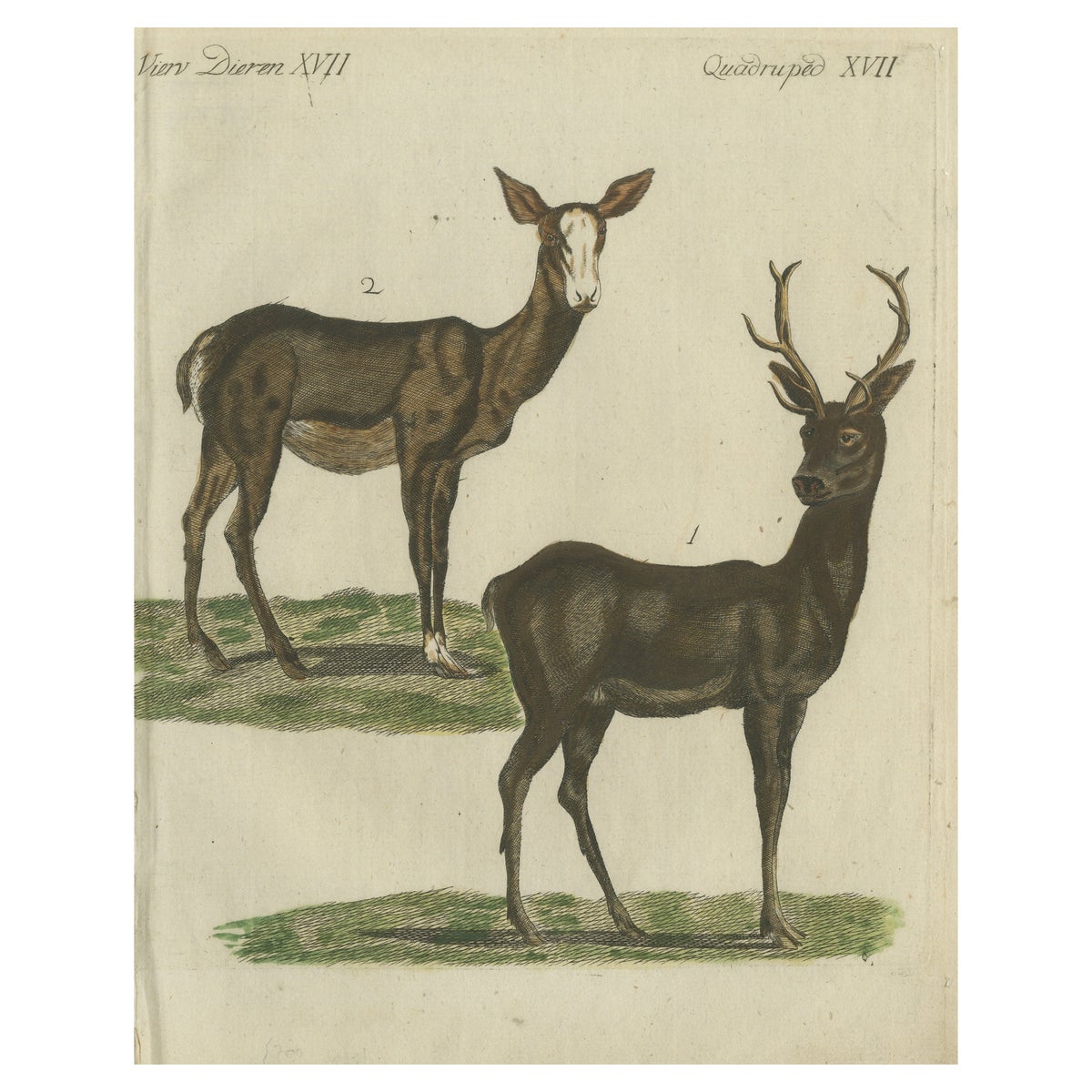


Hand-Colored Antique Engraving of a Male and Female Deer, Published in 1820
$180 (£135, €160)
Period original, not a reproduction.
Shipped from the Netherlands, flat, insured and tracked, worldwide. Returns accepted within 14 days.
- Date
- 1820
- Size
- 10.1 × 7.8 in (25.6 × 19.7 cm)
- Condition
- Good. General age-related toning. Small punch holes in right margin. Some wear and soiling. Blank verso. Please study image carefully.
- Period
- Early 19th century
- Artist or book
- Bertuch
- Section
- Mammals
- Reference
- f_38510112
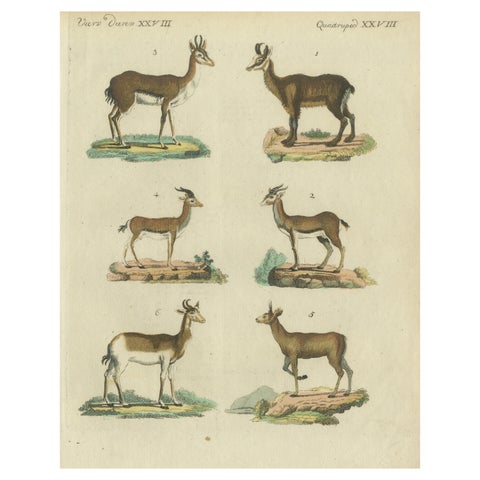
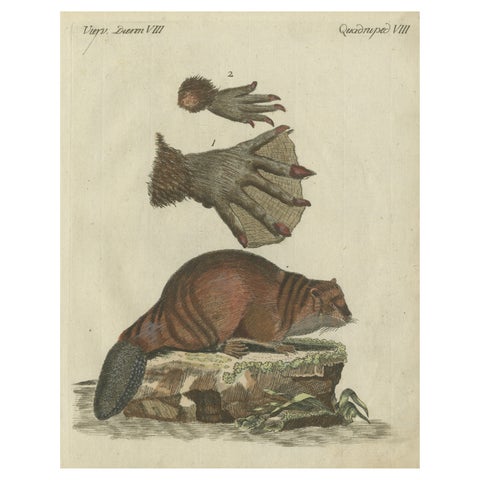
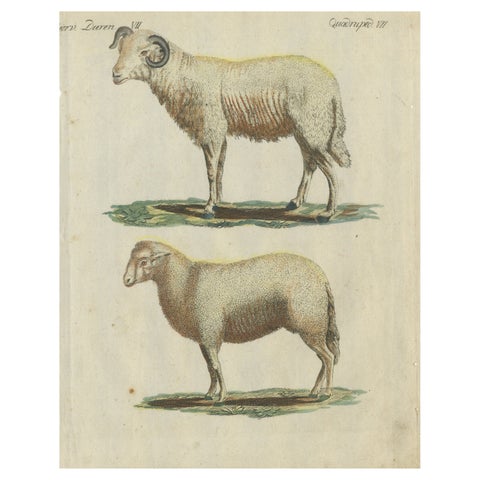
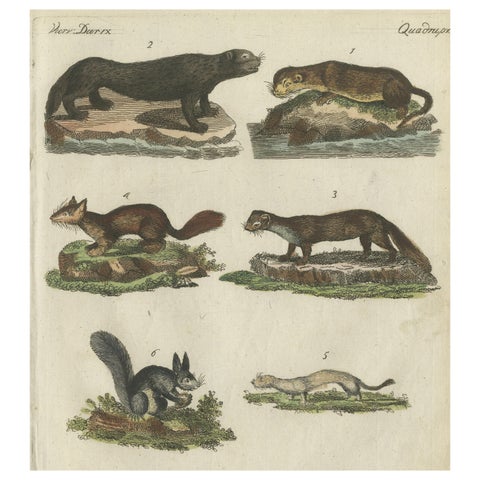
Original antique print of two deer. his engraved print originates from a very rare unknown Dutch work. The plates are similar to the plates in the famous German work: ‘Bilderbuch fur Kinder' by F.J. Bertuch, published 1790-1830 in Weimar. This could be Dutch edition of this work (no references found), or a work that used the Bertuch plates. Published circa 1820.
Two deer-like animals labeled "Viverr. (Dutch: Viervoeters) Dieren XVII" and "Quadrup. XVII", suggesting that it is the seventeenth entry in a series of quadruped illustrations.
1. **Top (Number 2)**: This animal is likely a female deer, indicated by its lack of antlers and the slender, graceful build. Its coat is a uniform brown, and it's depicted in a side profile with its head turned toward the viewer, displaying a calm demeanor.
2. **Bottom (Number 1)**: The second animal is a male deer, as evidenced by its prominent antlers. It has a darker coat compared to the first and is depicted in a frontal view, showcasing the full spread of its antlers and the muscular build of its shoulders and chest.
Both animals are presented standing on patches of grass, with the focus of the illustration being on their physical characteristics, such as the texture of their fur, the structure of their limbs, and in the case of the male, the branching of the antlers. The detailed rendering of these features is typical of scientific or educational natural history illustrations from the 18th or 19th century. These images would have been used to study and document different species, as well as to educate others about the diversity of wildlife. The posture and expressions of the animals are captured with a sense of realism, conveying both their physical traits and a hint of their natural behavior.