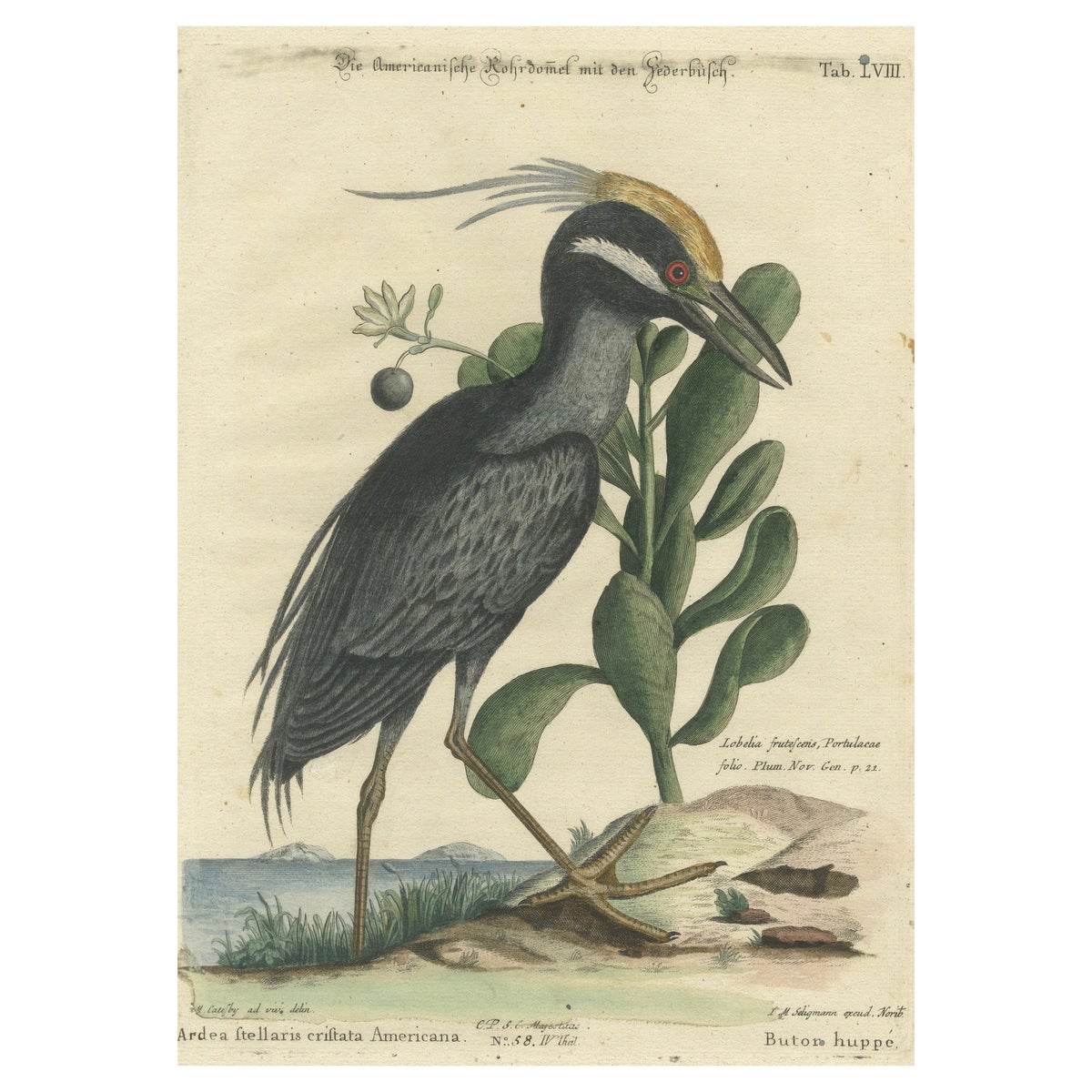


Hand-Colored Engraving of the American Crested Bittern by Seligmann, ca.1770
$695 (£525, €620)
Period original, not a reproduction.
Shipped from the Netherlands, flat, insured and tracked, worldwide. Returns accepted within 14 days.
- Date
- 1770
- Size
- 14.6 × 9.8 in (37 × 25 cm)
- Condition
- Good. Vibrant colors, minimal fading. Paper shows light toning and minor foxing. Edges sharp; no tears, no folds. Some handling marks, mostly outside plate-mark, not affecting image quality. Please study the images carefully.
- Period
- 18th century
- Section
- Birds
- Reference
- f_42305232
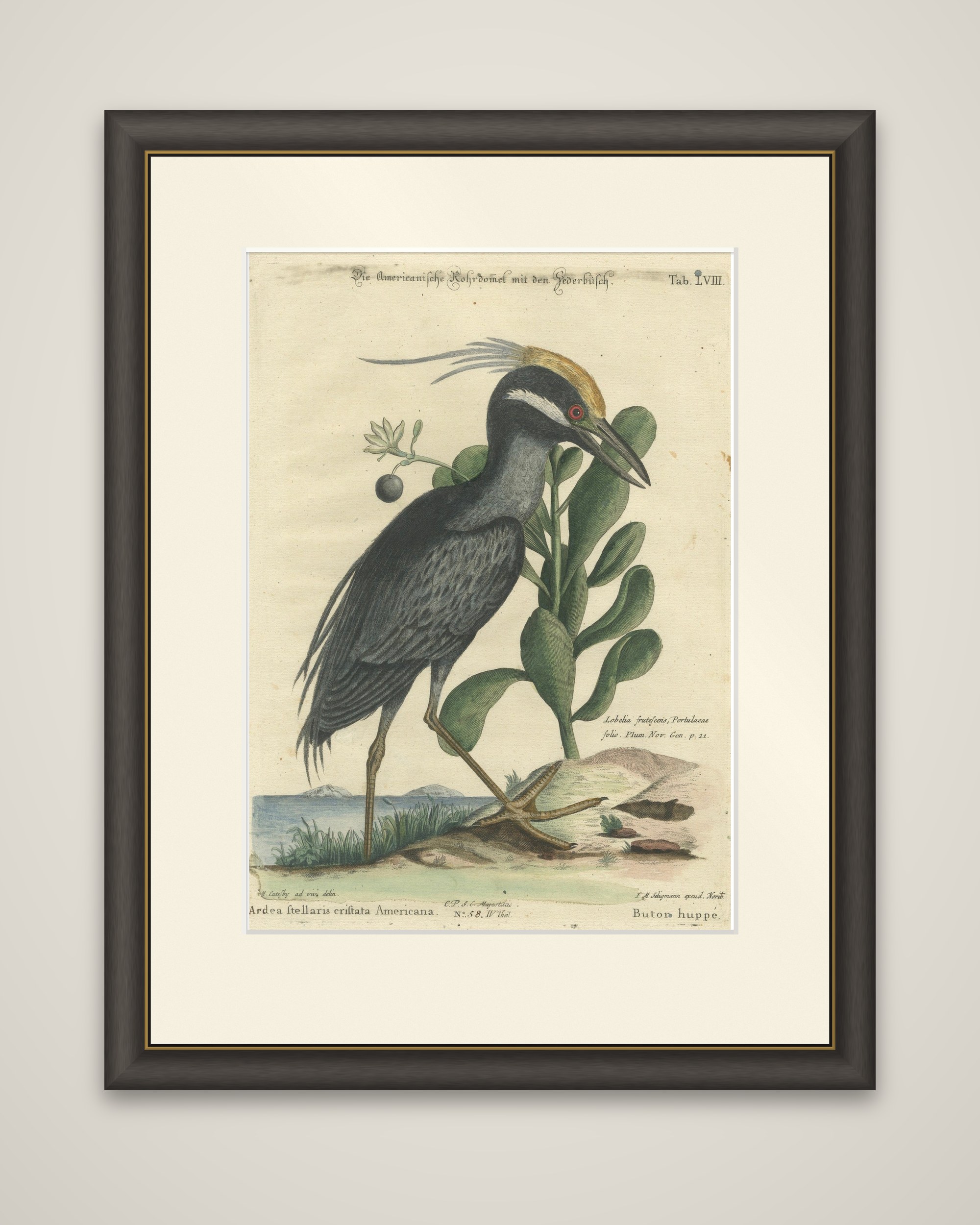
A crested heron from the American coast, titled "Die Americanische Rohrdomel mit den Federbusch", an original hand-colored copperplate engraving from Johann Michael Seligmann's Sammlung verschiedener ausländischer und seltener Vögel, Nuremberg, circa 1770. The plate is numbered "Tab. LVIII" at the upper right and lettered below with the Latin "Ardea stellaris cristata Americana", "N° 58 IV Theil" and the French "Butor huppé", with the credit "M. Catesby ad vivum delin." at the lower left.
The bird is shown in a striding pose, one foot raised, against a shoreline. Its body is slate gray with dark feathering on the wing, and the head is black with a broad white stripe behind the eye, a red eye, a yellowish-orange crown and a thin white plume trailing back from the head. The legs and long toes are yellow-brown. Behind it, a leafy plant with thick oval leaves carries a white flower and a dark round fruit, and a small label at the right names it "Lobelia frutescens, Portulacae folio. Plum. Nov. Gen. p. 21". At the left, blue water and low hills lie behind a bank of grass.
Mark Catesby often paired his birds with the plants they were found among, and Seligmann's edition kept the pairing, with the plant citations for Plumier's work giving the reader a reference to follow.