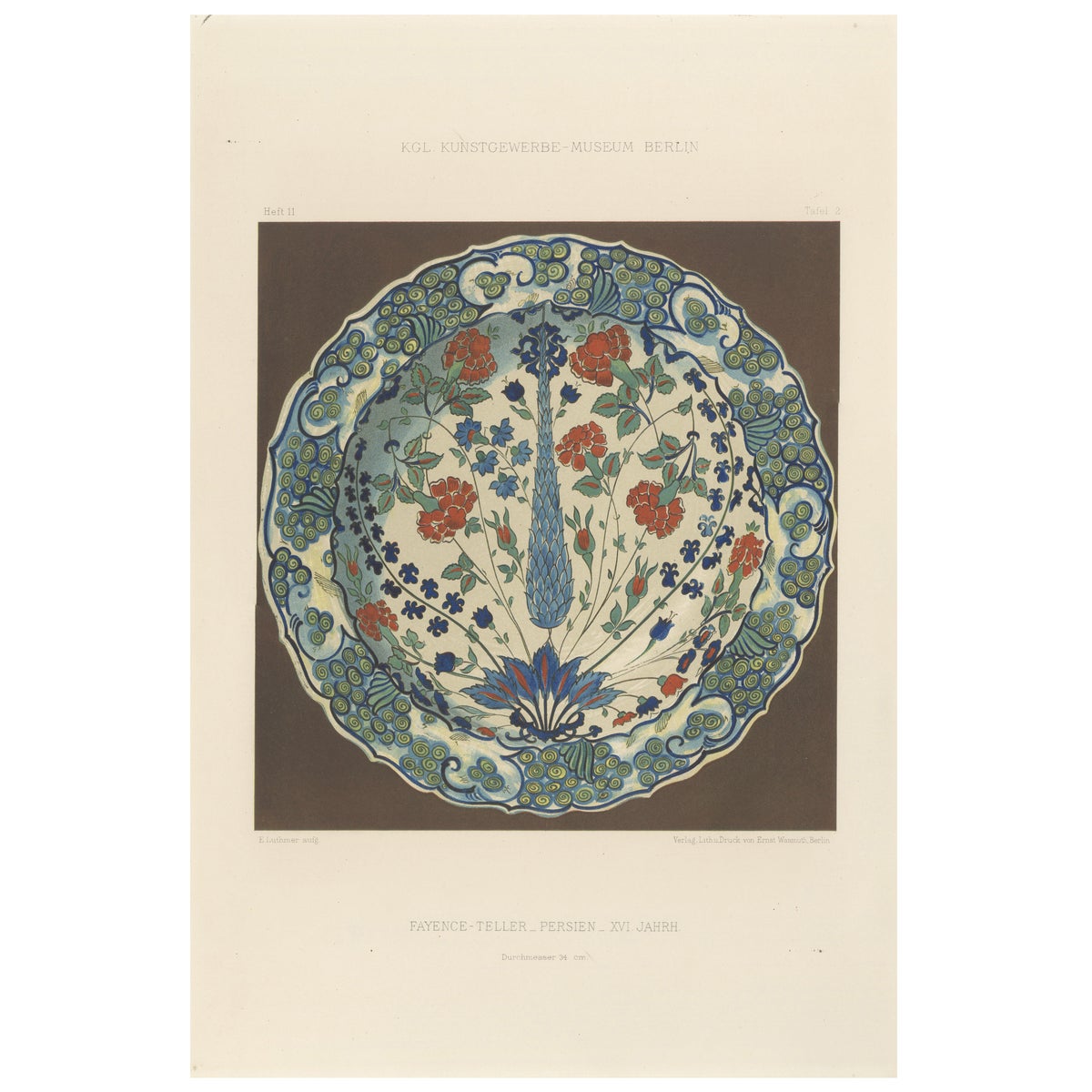


Persian Iznik-Style Faience Plate, Floral Design, Julius Lessing, Berlin 1890
$380 (£290, €340)
Period original, not a reproduction.
Shipped from the Netherlands, flat, insured and tracked, worldwide. Returns accepted within 14 days.
- Date
- 1890
- Size
- 19.3 × 13 in (49 × 33 cm)
- Condition
- Good. Excellent condition with vibrant, well-preserved colors and wide margins. Light age toning and minor handling marks in the margins consistent with age. Image area bright and clean.
- Period
- Late 19th century
- Section
- Botanical
- Reference
- f_47341622
Persian Iznik-Style Faience Plate with Floral Design, Julius Lessing, Berlin 1890
Beautiful chromolithograph from Persisch-Türkische Fayencen. Teller (Persian-Turkish Faience Plates), published by Julius Lessing in Berlin, 1890, as part of Vorbilder-Hefte aus dem Kgl. Kunstgewerbe-Museum, Heft 11. This stunning plate illustration reproduces a 16th-century Persian faience dish from the collection of the Royal Museum of Decorative Arts in Berlin (Kgl. Kunstgewerbe-Museum Berlin).
The depicted plate is a masterpiece of Islamic ceramic design, characterized by a central stylized floral stem surrounded by delicate red carnations, blue tulips, and arabesque tendrils. The intricate scalloped border, filled with swirling blue and green spirals, enhances the rhythmic harmony of the piece. The color palette of cobalt blue, turquoise, sage green, and coral red is emblematic of the celebrated Iznik and Persian pottery traditions of the 16th century, representing the perfect fusion of Persian and Ottoman artistic influences.
Julius Lessing (1843–1908), a leading German art historian and director of the Berlin Museum of Decorative Arts, created this series to preserve and promote world ornamental traditions as inspiration for modern design and applied arts. Each lithographic plate was executed with the highest chromatic precision by the publisher Ernst Wasmuth, ensuring faithful representation of glaze tones and textures.
This work remains an important record of Islamic decorative heritage and a fine example of 19th-century chromolithographic craftsmanship. The Vorbilder-Hefte series was admired throughout Europe for its role in educating designers, craftsmen, and architects about historical ornament and color composition.
Condition report:
Excellent condition with vibrant, well-preserved colors and wide margins. Light age toning and minor handling marks in the margins consistent with age. Image area bright and clean.
Framing tips:
A wide ivory or off-white mat combined with a slim gold or dark mahogany frame will accentuate the vivid colors and intricate design. Perfect for pairing with other plates from the same series to create an elegant wall ensemble.
Technique: Chromolithograph
Maker: Julius Lessing, Berlin, 1890