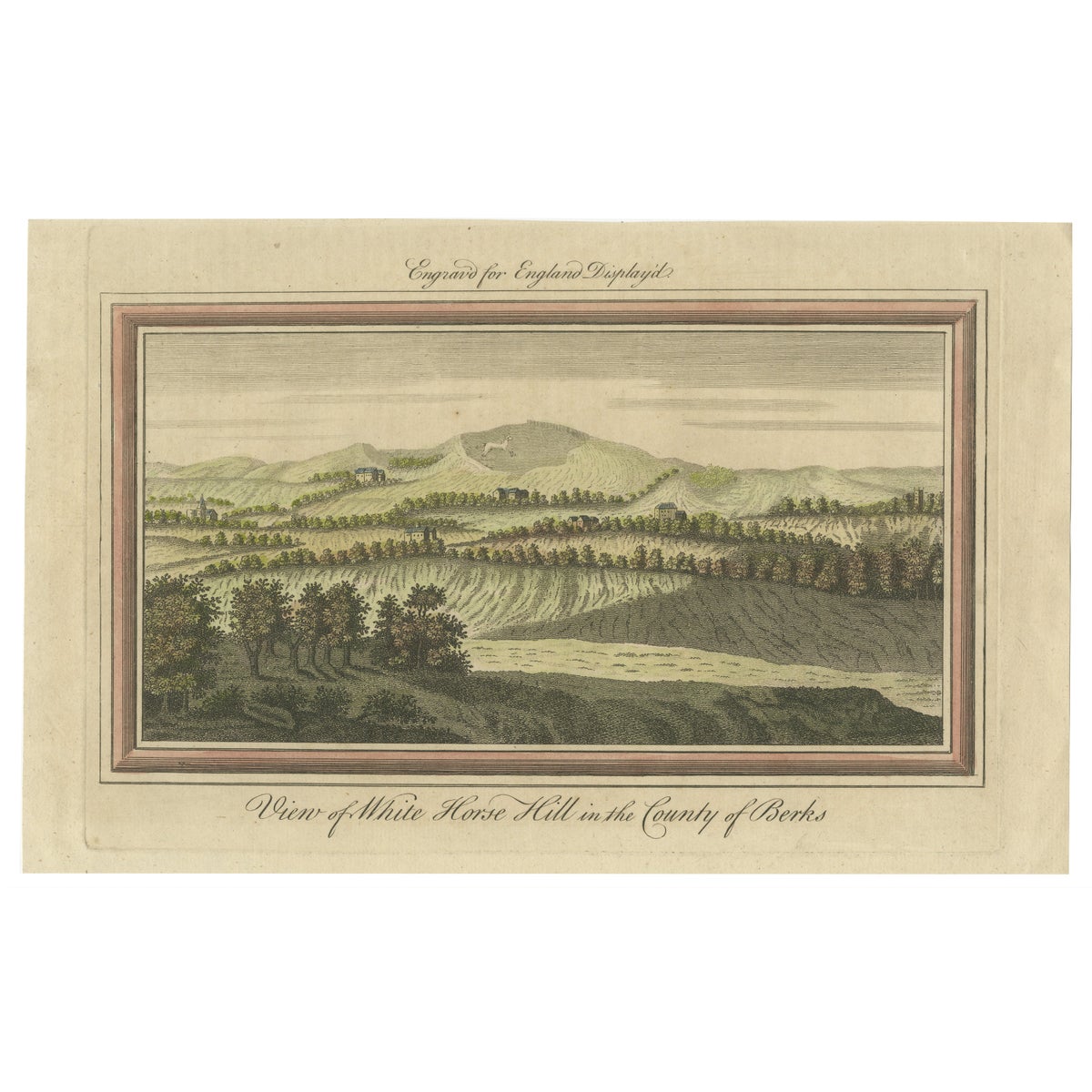


Old Engraving of White Horse Hill in the County of Berkshire, England, c1800
$145 (£110, €130)
Period original, not a reproduction.
Shipped from the Netherlands, flat, insured and tracked, worldwide. Returns accepted within 14 days.
- Date
- Not stated
- Size
- 7.3 × 11.6 in (18.5 × 29.5 cm)
- Condition
- Good. Good. The sheet overall a little browned. General age-related toning and/or occasional minor defects from handling. Please study scan carefully.
- Section
- Mammals
- Reference
- f_38424422
A scene of White Horse Hill, which is located in the county of Berkshire.
The text in the image states: "Engrav'd for England Display'd" and "View of White Horse Hill in the County of Berks." This indicates that the image is likely an engraved illustration from a publication titled "England Display'd." It depicts a scene of White Horse Hill, which is located in the county of Berkshire (historically abbreviated as Berks) in England.
White Horse Hill is known for the Uffington White Horse, a prehistoric hill figure that is visible from afar. The illustration appears to be a hand-colored engraving, a common practice for detailed illustrations in books during the 18th and 19th centuries. This technique involved engraving an image onto a surface, such as a copper plate, which was then inked and used to print the image onto paper. Hand coloring was then applied to the printed image to give it a vibrant and lifelike appearance.
The scene itself portrays a pastoral and serene landscape, with rolling hills and a prominent hill figure, which is likely the White Horse. The presence of buildings and foliage suggests human habitation and cultivation of the land. The engraving style suggests that this work was likely created sometime between the 17th and 19th centuries, a period when such representations of the English countryside were popular in print. The level of detail and the style of the buildings could provide further clues to the exact date of the work with more historical context.
More research needed.